
No one warns you about the drawer. The one that gradually fills with syringes, alcohol swabs, medication vials, and sharps containers – sitting in your bathroom like an untouched time bomb made of everything you continually put into it. Here at Ekmi Fertility we get patients going through IVF and surrogacy every single day, and we understand that the clinical side of this journey is only one part of the picture. The other half is still, utterly human. IVF stimulation is hard. But if you are aware of what is coming, and have team who truly has your back, it makes all the difference.
 Most of the injections into the abdomen – subcutaneous, or just beneath the skin. They sting briefly. They turn into routine sooner than you think. Your fertility doctor and nurse train you extensively before you ever have to touch a syringe on your own.
The Injections: What You Are Taking and Why
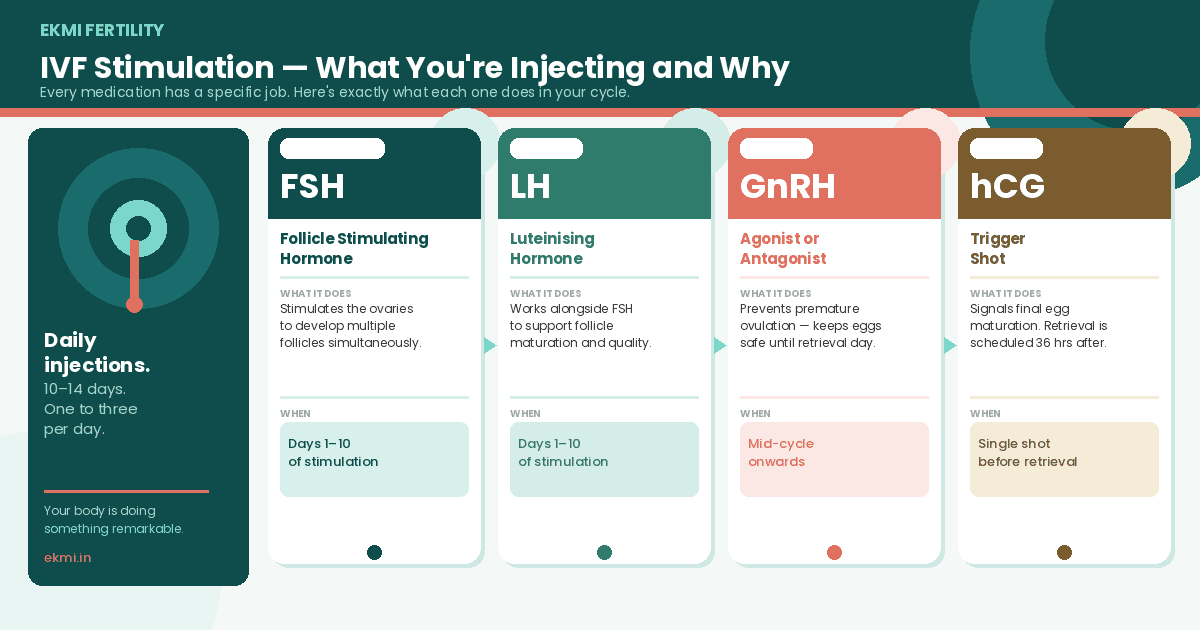
This is because while you are undergoing what we term as ovarian stimulation, your body requires a certain level of hormonal support in order to grow multiple follicles instead of the single follicle that it normally would. This is where the daily injections come into play. Classes of medications most commonly used in an IVF stimulation cycle:- FSH (Follicle Stimulating Hormone) – tells the ovaries to develop a few follicles
- LH (Luteinising Hormone) – works in conjunction with FSH to help follicles mature
- GnRH agonist or antagonist – suppresses the natural gonadotrophin release, preventing premature ovulation during stimulation
- Trigger shot (hCG or GnRH) – causes the eggs to mature just prior to being retrieved
 Most of the injections into the abdomen – subcutaneous, or just beneath the skin. They sting briefly. They turn into routine sooner than you think. Your fertility doctor and nurse train you extensively before you ever have to touch a syringe on your own.
Daily Management of Injections
Few things that really do help.- Keep the same hour everyday – it helps your hormone levels have less variance
- Firstly, you need to ice the area – 30 seconds of cold takes away a lot of sting
- Change injection sites – stops skin from becoming sensitive in any one place
- Log it simply – date, med, dose, time. Your IVF team – or surrogacy doctor, if you are also a surrogate – will appreciate it
- Don’t if you can avoid it – a partner or trusted person giving injections together makes the moment less tense, a shared experience
Monitoring Appointments: More Important than You Think!
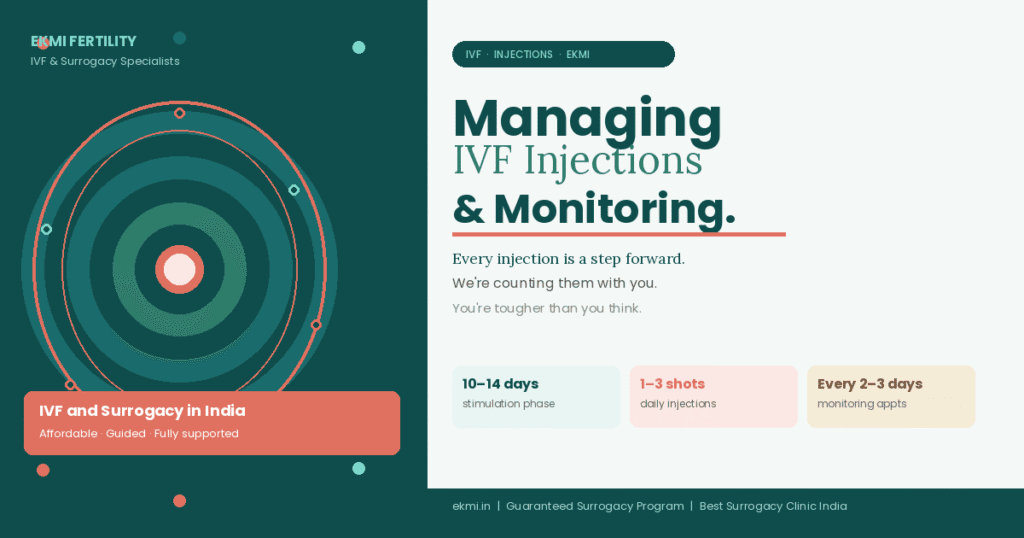
On average, your clinic will call you in every 2-3 days during stimulation for an ultrasound and blood work. These are not mere formalities – these are your cycle’s steering wheel. What monitoring checks:- Follicle count and growth rate
- Estrogen levels to track response
- Whether the protocol needs adjusting
- Timing for egg retrieval