
Both surrogacy and IVF are among the most magical things that modern medicine enables us to do – have a child when no other option seems at all viable. But anyone who has been down this road knows it’s not always a straight line. The time when a healthy embryo, transferred to an ideal surrogate – and we are talking here about a surrogate prepared like for a queen-just does not stick, is one of the hardest. No clear reason. No warning. Just a bad result with no clear cause for anyone involved – intended parents, fertility specialists and the surrogacy mother herself. This is what science really says to us.
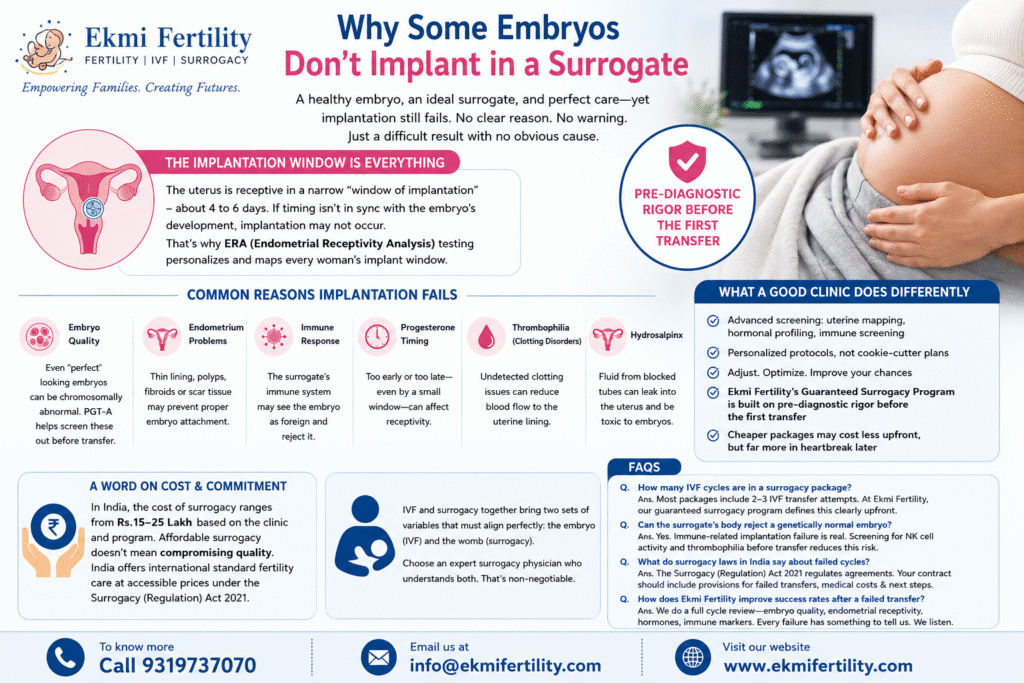
The Implantation Window Is Everything
A healthy chromosomally normal embryo can still fail if timing is slightly off. The uterus is only receptive in a narrow “window of implantation” – about 4 to 6 days. If the surrogate’s uterine-inner layers aren’t measured up to (in timing) with the development time of the incipient organism, the hatchling basically goes through. Which is why ERA (Endometrial Receptivity Analysis) testing has been a revolution at the bigger fertility clinics across the globe. Instead of using a standard timeline, this personalized model maps every woman’s implant window.
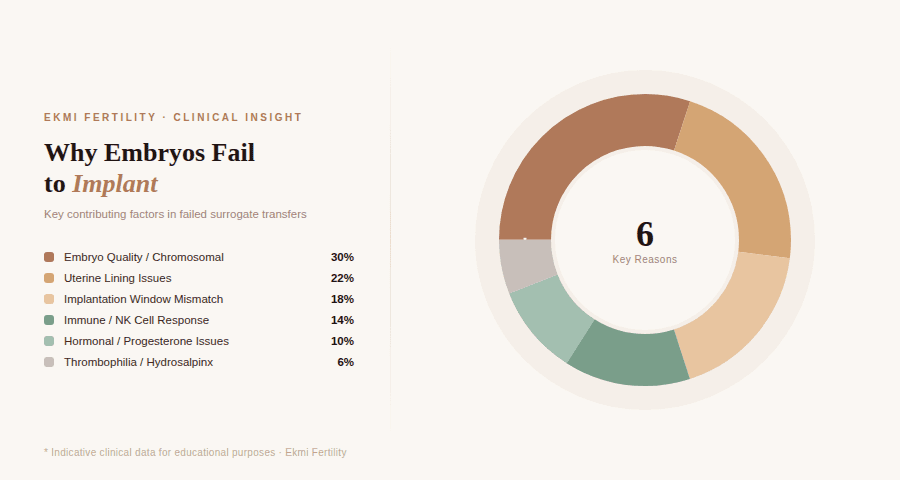
Common Reasons Implantation Fails
- Embryo quality – Even “perfect” looking embryos can be chromosomally abnormal. PGT-A (preimplantation genetic testing) helps to screen these out before transfer
- Endometrium problems – Thin endometrial tissue, polyps, fibroids or scar tissue may not allow the embryo to be able to attach as it should
- Immune response – Sometimes the surrogate’s immune system can see the embryo as a foreign entity and reject it.
- Progesterone timing – You need to hit it, very closely; if you stray out of a narrow window your receptivity is affected
- Thrombophilia (clotting disorders) – These are undetected blood-clotting problems which can slow blood flow to the lining of uterus
- Hydrosalpinx – Fluid from blocked fallopian tubes may leak over to the uterine cavity and be toxic to embryos
What a Good Clinic Does Differently
And this is where it really matters to select the right surrogacy clinic. All surrogates at Ekmi Fertility are screened before transfer: uterine mapping, hormonal profiling, immune screening. We don’t do cookie-cutter protocols. We adjust. And this is the exact principle behind our guaranteed surrogacy program: pre-diagnostic rigor before the first transfer, not post-failure.
Surrogacy packages that omit this step are cheaper initial outlays but far more costly in heartbreak later on. Thoughts of IVF and surrogacy jointly supply two sets of variables that must match perfectly: the embryo (IVF) then the interiors of the womb (surrogacy). An expert surrogacy physician who knows both, and that is not something you can compromise.
To know more Call 9319737070 or email us at info@ekmifertility.com
A Word on Cost and Commitment
In India, the cost of surrogacy is much lower than any other nation – ranging from Rs.15-25 Lakh based on the clinic and program. Affordable surrogacy doesn’t mean compromising the quality of service; instead, India provides international standards fertility care at accessible prices as the Surrogacy (Regulation) Act 2021 retains principles of ethical practice in a transparent manner. Failed implantation is painful. But few things are ever the end of a journey.
FAQs
Q. How many IVF cycles are in a surrogacy package?
In most cases, the surrogacy packages include 2-3 IVF transfer attempts. At Ekmi Fertility, this is clearly defined up front by our guaranteed surrogacy program – no grey area.
Q. Can the surrogate’s body reject a genetically normal embryo?
Yes. Immune-related implantation failure is real. Before transfer, screening for NK cell activity and thrombophilia has been reported to greatly reduce this risk.
Q. What do surrogacy laws in India say about failed cycles?
The Surrogacy (Regulation) Act 2021 regulates the agreements between any parties. An appropriate surrogacy doctor will inform you that your complete contract should incorporate provisions for what to do in case of a failed transfer, medical expenses incurred, and what to do next.
Q. How does Ekmi Fertility improve success rates after a failed transfer?
Before we give it another go, we do a full cycle review – embryo quality, the endometrial lining and its receptivity to an implanted embryo; hormone levels; immune markers. Every unsuccessful transfer has something to tell us. We listen to it.
To know more Call 9319737070 or email us at info@ekmifertility.com