

Receiving the results from your hormone test can be overwhelming. Numbers, ranges, abbreviations – that’s a lot to digest when you’re anxious about your fertility. At Ekmi Fertility, we think you shouldn’t require a medical degree to comprehend what’s going on in your body. Here’s a closer look at what those hormone levels actually mean, and why they are potentially important for your fertility journey.
Key Fertility Hormones You Need to Know
Your reproductive system operates on a fragile chain of hormones. When just one is off, it can impact your fertility. Here’s what we evaluate when we run your fertility hormone tests:
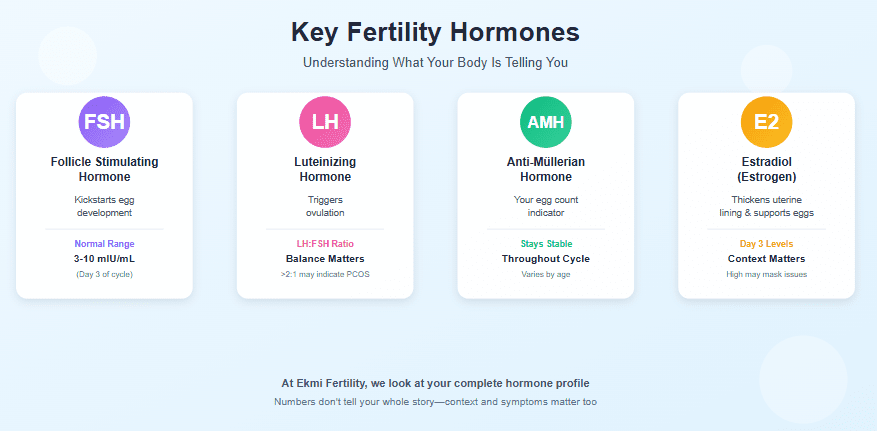
FSH (Follicle Stimulating Hormone)
This hormone triggers egg development each month. Elevated FSH may be a sign of diminished ovarian reserve, which suggests your ovaries are working overtime to produce eggs. A normal range is usually considered to be 3-10 mIU/mL on day 3 of your cycle, but context is always more important than a number by itself.
LH (Luteinizing Hormone)
LH triggers ovulation. The comparison of LH to FSH says much. An LH:FSH ratio above 2:1 is frequently indicative of PCOS. What we’re after here is a balance, not just isolated numbers.
AMH (Anti-Müllerian Hormone)
Consider AMH as your raw egg counter. Unlike other hormones that change with your cycle, AMH remains relatively constant. Low levels may mean that very few eggs are continuing to stay in reserve, and high levels could be a symptom of PCOS. The average ranges vary with the age, and that’s why we make decisions based on every individual person.
Estradiol (E2)
This estrogen type helps to thicken your uterine lining and stimulate the development of your egg. Too high on day three of your cycle? Perhaps it’s inhibiting FSH, covering up the issues with ovarian reserve. Too low? Your ovaries might not be very responsive.
Interpreting Your Hormone Tests for PCOS
PCOS messes with how your body uses insulin and the way it makes hormones. When interpreting hormone test results for PCOS – we want to see:
Elevated LH levels with normal or low FSH
High testosterone or DHEAS levels
AMH high (often > 5 ng/mL)
Insulin resistance markers
The thing with PCOS is that no two women have the same experience. It’s your hormone profile that helps us devise a treatment plan that can succeed with your body.
To know more Call 9319737070 or email us at info@ekmifertility.com
Thyroid and Prolactin: The Supporting Cast
TSH (Thyroid Stimulating Hormone)
Your thyroid regulates metabolism, but it also impacts fertility. TSH has been found to impair ovulation ABB 3, increase the risk of miscarriage ABB 4 and women with TSH levels >2.5 mIU/L have a significantly higher frequency of aneuploidy in their embryos when compared to euthyroid controls. When trying to conceive, we want your TSH between 1-2 mIU/L.
Prolactin
Increased prolactin levels can completely suppress ovulation. If they are high, we will look into the reasons before we embark on any fertility treatment at all.
What Your Fertility Hormone Test Results Mean for Treating Infertility
So, here’s the thing: numbers don’t tell your whole story. What we look at in Ekmi Fertility:
From your daily hormone balance (in contrast to piecemeal values)
How different hormones work together
Your symptoms and menstrual patterns
Your age and fertility goals
Previous pregnancy history
There’s nothing magical about even moderately elevated FSH that says it’s impossible for you to become pregnant. A low AMH does not mean IVF is your only choice. We take these as a conversation starter, not a last word.
To know more Call 9319737070 or email us at info@ekmifertility.com
Next After You Get Your Worth Back
After we look together at your levels of fertility hormones, I’ll talk with you about whether you require:
Making lifestyle changes (diet, exercise, managing stress)
Medication to regulate hormones
Ovulation induction protocols
IVF with personalized stimulation plans
Our hormone profile directs our approach, but it doesn’t restrict your options.
FAQs
Q: When is it time to get tested for fertility hormones?
You can have FSH, LH and estradiol blood test performed on day 2-4th of your cycle. You can be tested for AMH and thyroid any day.
Q: What is a typical AMH level for my age?
AMH declines with age. Normals 20s (2.0-6.8 ng/mL) 30s (1.7-3.5 ng/mL) and 40s (0.5-2.5 ng/mL).
Q: Can hormone levels improve on their own?
Yes. Weight control, stress therapy and specific supplements can fine-tune hormone balance for most women.
Q: How frequently should I have my hormone levels retested?
As required – usually every 3-6 months during treatment or annually if screening ovarian reserve with age.
To know more Call 9319737070 or email us at info@ekmifertility.com