

Choosing to have a family through surrogacy or IVF is, in itself, a leap. For NRI couples, there is the added layer – of travel, paperwork, time away from work and where to even start. In India world-class fertility specialists, the right legal setups, and genuinely cost-effective surrogacy in comparison to Western countries has made this country one of the most preferred destinations for IVF and surrogacy in India. But to make the journey smooth takes some planning well before your flight touches down. Here are some documentation tips for NRI couples.
Before You Travel: Documentation First
This is the point at which most couples lose time. Get these sorted early:
- Holders of valid passports (validity: 18 months or more)
- Medical visa: medical – specifically for fertility treatment, not a tourist visa
- Marriage certificate (apostilled or attested)
- Physical evidence of being unable to conceive or medical needs from a physician
- NRI/OCI card copies
- Death or other irretrievable events at any stage power of attorney if one partner travels alone
Where to Stay & For How Long
Plan for at least two visits. The first is for consultations, diagnostics and signing agreements with mother the surrogate. The latter is nearer to delivery. Some couples go a third time halfway through the pregnancy for reassurance.
What to look for in accommodation:
- A clinic is best 15–20 minutes max from you
- Served flats over hotels (you’ll be cooking, resting, recovering)
- Telehealth follow up between visits requires a reliable wi-fi
- If you are in Delhi NCR, choose areas like South Delhi, Gurugram or Noida
Understanding the Cost Upfront
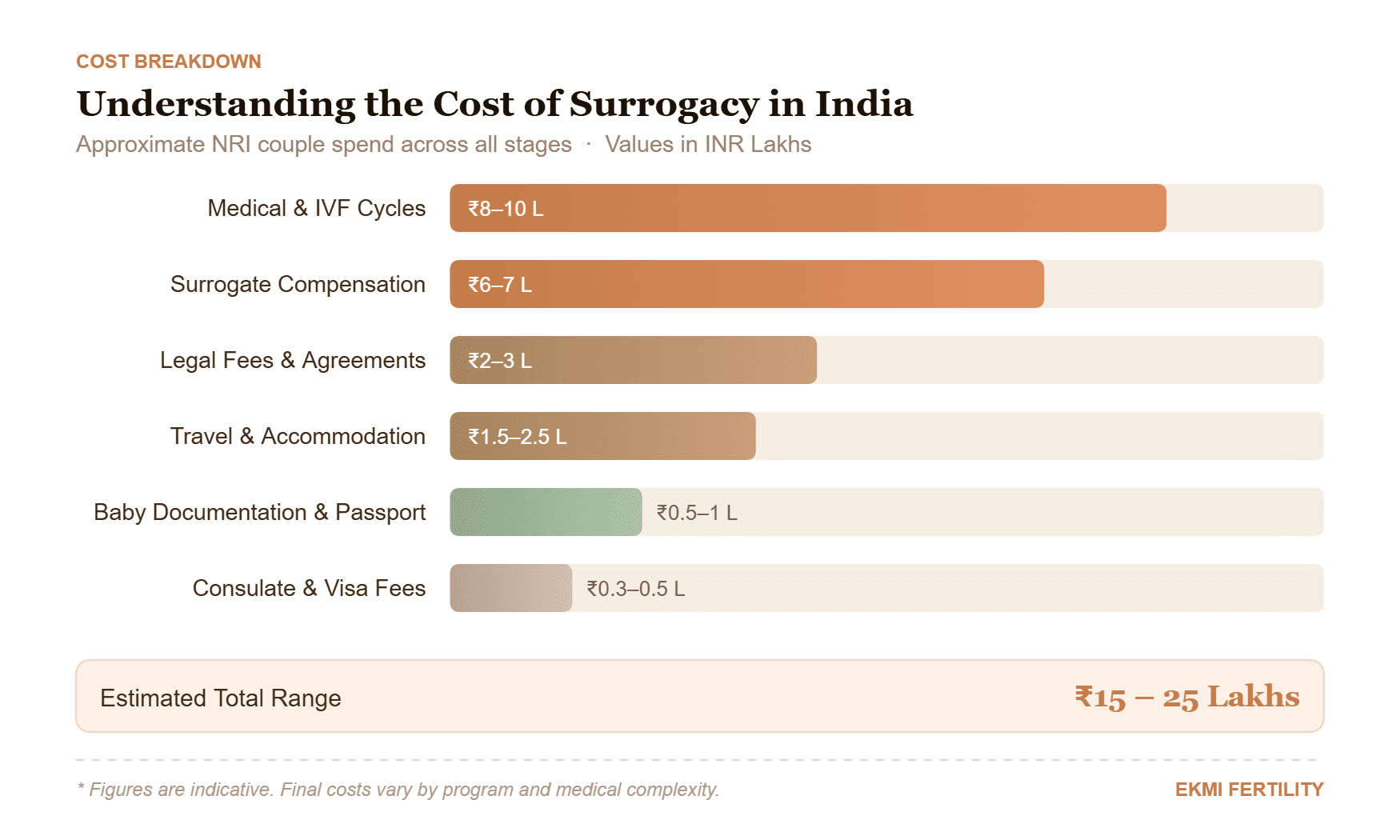
The cost of surrogacy in India depends on the program, medical complexity, and legal requirements. The ballpark estimate is Rs.15–25 lakhs, depending on the inclusion or exclusion of IVF cycles. But here’s the thing – surrogacy cost is more than a medical bill. Factor in:
- Legal fees and surrogate compensation
- If you had to attend and count travel and accommodation through several visits
- Formalities in your country’s Indian consulate after birth
- Newborn documentation (birth certificate, passport, visa for the baby)
This reality means seeking a knowledgeable surrogacy doctor in India, one who can help you understand the entire landscape, not just the headline number.
To know more Call 9319737070 or email us at info@ekmifertility.com
Post-Birth: Getting Your Baby Home
This is where many NRI couples fumble. Once the baby is born:
- Apply and get the birth certificate as soon as possible
- If your home country requires DNA testing, then do it
- First apply for an Indian passport for the baby, and then a visa from your nearest country’s consulate
- If you are traveling, carry all surrogacy agreements and court orders
Start this process before birth. Delays occur when you do not have your paperwork ready.
FAQs
Are NRI couples legally allowed to go ahead with surrogacy in India?
Yes, provided married NRI couples can demonstrate a medical need as per provisions of the Surrogacy (Regulation) Act. Speak with a surrogacy doctor in India about your case.
How many IVF cycles does a surrogacy program include?
Most surrogacy guarantees in India include 2–3 attempts at IVF. Ekmi Fertility provides upfront cycle inclusion details.
How does IVF differ from surrogacy?
IVF is a fertilization process. Surrogacy uses a surrogate mother to carry the embryo. They normally go hand in hand – IVF makes the embryo, surrogacy bears it.
Is the surrogacy cost in India negotiable?
Package structures are different, but the medical components are fixed. The affordable surrogacy in India benefit lies in the overall, much lower pricing compared to US or UK – not skimping.
To know more Call 9319737070 or email us at info@ekmifertility.com